

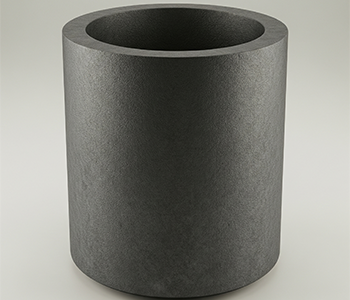
Cylindrical Graphite Crucibles
A cylindrical graphite crucible is a melting container with a simple, straight-walled cylindrical shape, a flat bottom, and typically no spout. This design makes it well-suited for a variety of high-temperature applications, especially in furnaces where the crucible sits upright and is not tilted for pouring. They are widely used in laboratories, foundries, and industrial settings for melting and holding metals.
Key Characteristics
The cylindrical shape of these crucibles is not just a matter of design but a functional feature that makes them ideal for certain applications.
- Uniform Heating: The symmetrical, cylindrical form allows for even heat distribution from a surrounding heat source, such as in an electric resistance furnace or an induction furnace. This ensures that the entire contents of the crucible are heated uniformly, leading to a consistent melt.
- Capacity and Space Efficiency: The cylindrical design maximizes the volume for a given footprint, making them highly efficient in furnaces where space is a constraint. They are available in a wide range of sizes and capacities, from small crucibles for a few grams of material to large ones holding tons of molten metal.
- High Purity and Performance: Similar to other graphite crucibles, cylindrical versions benefit from the excellent properties of graphite:
- High Temperature Resistance: They can withstand extremely high temperatures, often exceeding 3,000°C (5,400°F) in non-oxidizing environments.
- Thermal Conductivity: Graphite’s excellent thermal conductivity allows for fast melting and reduced energy consumption.
- Chemical Inertness: They do not react with most molten metals, which is essential for maintaining the purity of the final product.
Common Applications
Cylndrical graphite crucibles are a staple in various high-temperature processes, including:
- Induction Melting Furnaces: Their cylindrical shape is perfectly suited for the coils of induction furnaces. In some designs, the crucible itself is designed to heat the material, while in others, the induction field passes through the crucible to heat the metal directly. The crucible’s electrical resistivity must be carefully matched to the furnace’s operating frequency for optimal performance.
- Electric Resistance Furnaces: The simple, uniform shape is ideal for placement within the heating elements of an electric resistance furnace, ensuring even heat transfer from all sides.
- Metallurgy and Foundry: They are widely used for melting and holding non-ferrous metals and alloys such as gold, silver, copper, aluminum, and brass.
- Scientific and Research Laboratories: Researchers use small cylindrical crucibles for high-temperature synthesis, material analysis, and other lab-scale experiments.