

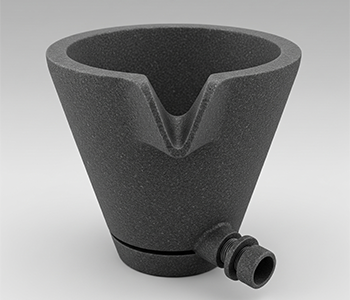
Bottom Pour Graphite Crucible
A bottom pour graphite crucible is a specialized type of graphite crucible with an outlet at the bottom, designed for controlled and precise pouring of molten materials. Unlike traditional crucibles that are tilted to pour, the bottom pour design allows for the controlled release of the liquid metal or other material from the base. This design is particularly useful in applications that require a high degree of control over the flow rate and a cleaner, more precise pour into a mold.
Key Features and How It Works
The defining feature of a bottom pour crucible is the stopper rod mechanism. The crucible has an opening at its base, which is sealed by a tapered stopper rod that extends down from above.
- Melting Phase: During the melting process, the stopper rod is in a closed position, tightly sealing the bottom opening and holding the molten material within the crucible.
- Pouring Phase: Once the material is fully melted and ready to be cast, the stopper rod is lifted or retracted. This action opens the passageway at the bottom, allowing the molten material to flow out in a controlled stream.
- Precision Control: The flow rate can be precisely regulated by adjusting the position of the stopper rod. This level of control is crucial for preventing splashing, reducing dross formation, and ensuring the mold is filled cleanly and evenly.
The entire apparatus is often integrated into a casting system, such as a vacuum casting machine, where the crucible, stopper rod, and mold are all part of a single, controlled environment.
Advantages of Bottom Pouring
The bottom pour design offers several significant advantages over traditional tilting crucibles:
- Increased Purity: Pouring from the bottom reduces the risk of transferring impurities or dross from the surface of the molten metal into the mold. Since impurities tend to float on top, bottom pouring ensures that the cleanest, purest metal at the bottom is poured first. This is particularly important for high-purity applications, such as in the precious metals and semiconductor industries.
- Controlled Flow: The stopper rod mechanism provides a high degree of control over the molten material’s flow rate, which helps in achieving consistent and defect-free castings.
- Reduced Splashing and Oxidation: A steady, controlled stream from the bottom minimizes splashing and the exposure of the molten metal to the air, thereby reducing oxidation and gas porosity in the final product.
- Greater Safety: The aautomated or semi-automated process of lifting a stopper rod is generally safer than manually tilting a heavy crucible filled with molten metal.
Common Applications
Due to their precision and ability to produce high-quality, pure castings, bottom pour graphite crucibles are used in a variety of specialized industries:
- Precious Metals Casting: Essential for casting high-value metals like gold, silver, and platinum into bars, jewelry, and other forms where purity and a smooth finish are paramount.
- Jewelry Manufacturing: Used in vacuum casting machines for creating intricate jewelry pieces with high precision and minimal defects.
- Aerospace and Automotive: Employed in the casting of high-performance alloys where material integrity and a low defect rate are critical for safety and functionality.
- Foundries and Metallurgy: Used for casting various non-ferrous metals and alloys where a clean pour and controlled flow are required for specific product specifications.